Talent does not scale
When the show outgrows the lead role
At some point I learned that, as an individual, there are certain things I can reliably fuck up. Not an elegant sentence, but a very useful realization.
Estimated reading time: 4 min
The one-man show works
Until it outgrows one person
For a long time, you can rely on speed, experience, intelligence, and improvisation to compensate for a lot. That often worked for me. I see systems quickly, recognize patterns, take technical, organizational, and political relationships apart, rearrange them, and turn them into something useful.
That is a real strength, and I have no intention of pretending otherwise.
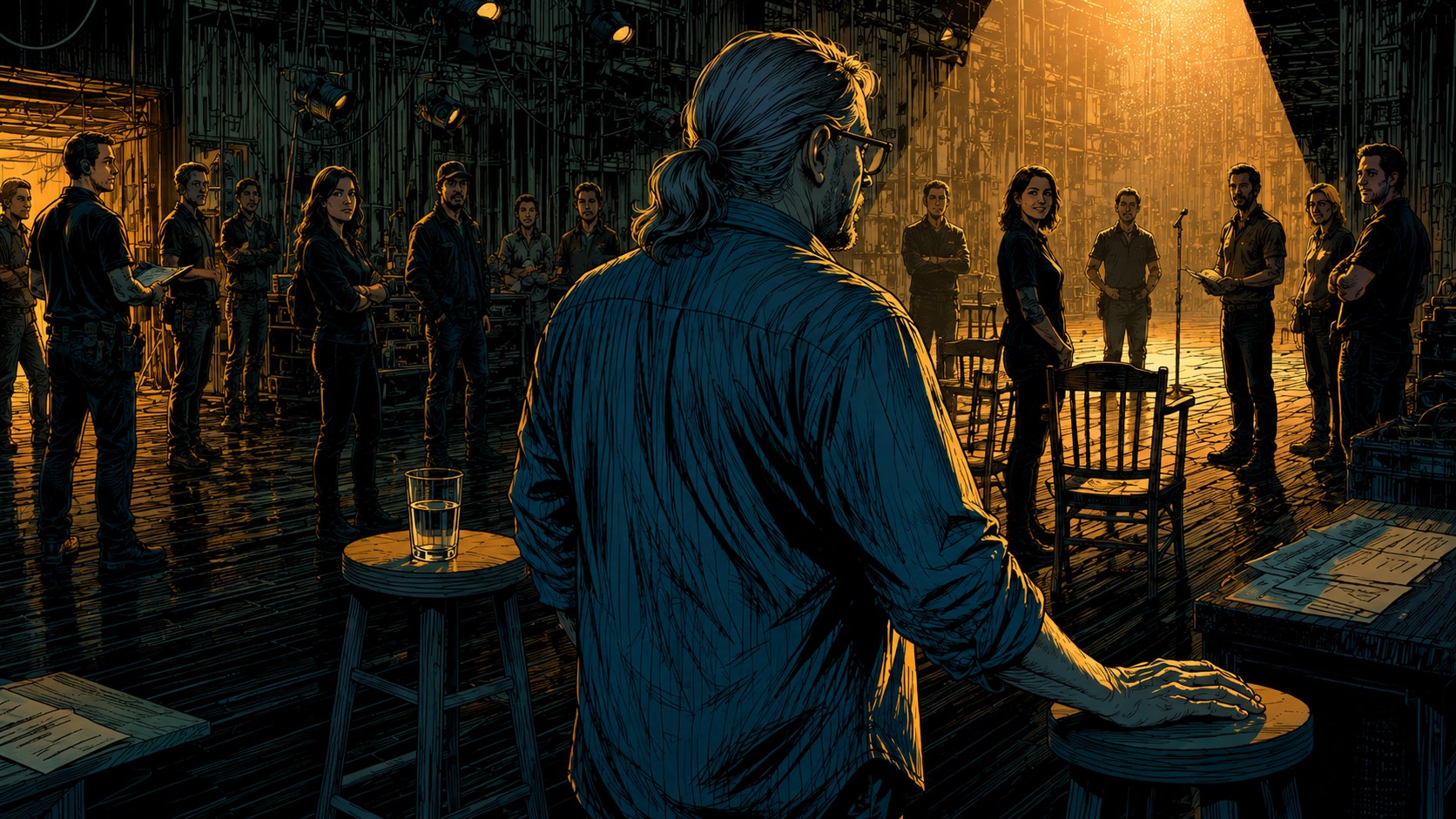
A good one-man show can get surprisingly far that way. One person is on stage with timing, reflexes, energy, and a dozen roles in their head. The audience stays with it. It can be impressive and sometimes even very successful.
But at some point, the solo act turns into a larger production. Then it is no longer enough for one person to stand at the front and hold everything together with talent, routine, and late nights. You need a cast, direction, timing, technology, production, structure, and people who can play their roles better than you ever could.
It took me a while to learn that lesson.
When one person becomes the risk
What versatility eventually costs
Things get difficult when personal versatility becomes the business model. Then it is about more than ideas, concepts, architecture, or strategy. It is also about invoices, deadlines, commercial structure, priorities, and ongoing responsibility — all the things that rarely look spectacular until they are missing.
When a company depends too heavily on one person, it may still look like a show from the front. Backstage, the scenery is already rattling.
I did not learn that from a startup bible, a pitch deck, or a framework with three English buzzwords and an arrow diagram. I learned it during a period when it became painfully clear that my existing model no longer worked. Too much had been built around me. Too much became difficult as soon as the work touched the areas I only ever dealt with reluctantly.
Restart instead of retreat
The old model no longer worked
There were plenty of reasons at the time to scale back and keep our heads down. A lot of people in that situation would probably have tried to break as little as possible and simply get through it.
We did the opposite.
We built a new company, moved to a new location, bought a house, and turned it into a new way of working. This was not some romantic fresh start with a sunrise and a string quartet. It was a pretty pragmatic move. The old setup no longer worked, so we built a better one. This time with roles based on more than hope.
The cast makes the difference
Roles instead of hope
Petra was not a supporting character in this, and she was not the person backstage bringing coffee while someone out front waved around big ideas — although Petra does make very good coffee. She took on exactly the functions without which the new model would never have become stable: commercial structure, organizational grounding, customer contact, and reliability.
A big show depends on having the right people in the right places. On not having every role played by the same person. On one person being strong exactly where someone else regularly drops the ball.
You do not have to do everything yourself
Strength comes from complementing each other
To this day, that remains one of the most important business lessons I have learned. Your own weaknesses stop being private once other people, customers, projects, or larger ventures depend on them. At that point, they become part of the architecture. You can ignore them, downplay them, or drown them out with energy — or you can take them seriously and design roles around them.
I need to know where I am strong. I need to know just as clearly where I regularly mess things up. Only then can I look for people who are steady where I become scattered. People who hold on while my mind is already three rooms ahead and who ask how something is actually going to be implemented, financed, organized, and sustained.
The wrong room
Complement matters more than ego
That is exactly why I like the line: if I am the best person in the room, I am in the wrong room.
It can sound arrogant. To me, it means almost the opposite. I am not looking for rooms where everyone nods. I am looking for rooms where other people are better than I am at different things, where disagreement is not treated as disruption, and where complementing each other matters more than ego.
Part of that is because my profile is not especially linear. On a traditional resume, it can look like a moving box that ended up in the wrong room. In practice, it is more like a toolbox. Some of it is specialized equipment, some improvised, and some of it other people never use because they would never think to connect those things in the first place.
I know I am pretty good at making those connections. Probably better than most. I can translate between worlds, see patterns before anyone has properly labeled them, and build a working model out of loose material.
And that is exactly why role clarity matters so much.
When ability has to become structure
The right cast carries the show
The more you can do, the longer you can convince yourself that somehow it will be enough. For a while, it is. Until the whole thing gets bigger and reliability matters more than brilliance at exactly the right moment. Until talent has to become a system.
That was the real point of our restart: rebuilding. The one-man show had to become something that still worked when one person was not simultaneously playing the lead, directing, doing the books, handling technology, sales, dramaturgy, and crisis management.
To me, that is still the core of being a founder: recognizing what system needs to be built, which roles are missing, which people are stronger in those roles, and how to bring them together.
I can do a lot of things. Some of them considerably better than most people.
The better show still does not emerge when one person simply takes on one more role. It emerges when the cast is right.
Personal versatility, speed, and improvisation can carry you surprisingly far. But once a company grows, individual weaknesses become part of the architecture. At that point, taking on one more role yourself is no longer enough. You have to recognize where others are stronger, distribute responsibility, and build a system that does not depend on a single person. A better show does not come from more solo performance. It comes from the right cast.
© Copyright 2026 Cybercraft GmbH