No straight path. A clear pattern.

a résumé that only reveals its logic when viewed backwards
I only meant to update my LinkedIn résumé. It sounds harmless enough, but apparently it is one of those tasks where you start sorting through a few career stops and suddenly realize that, somewhere along the way, you have ended up on the table yourself.
Estimated reading time: 4 min
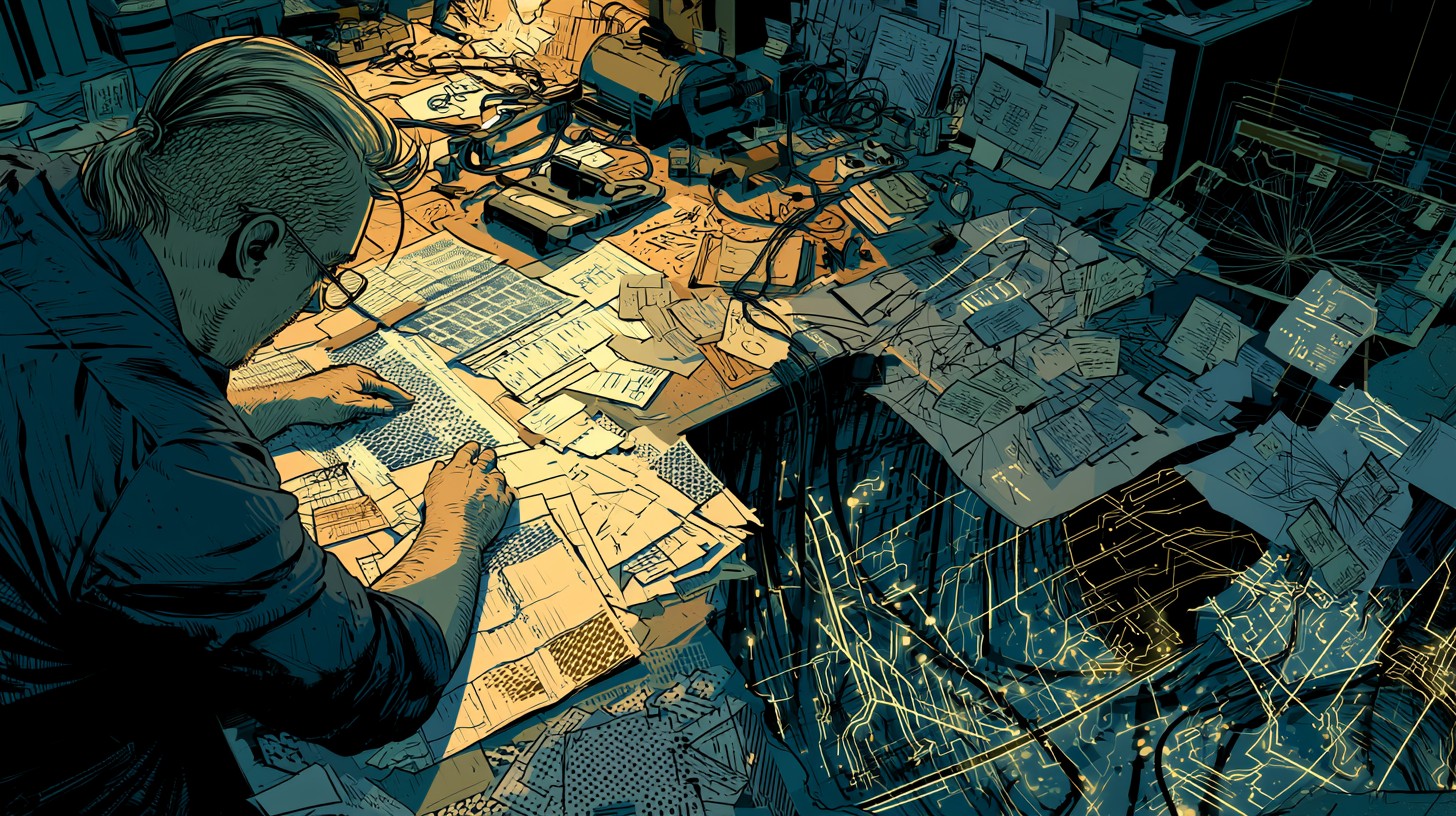
Some things were obvious,
others were buried somewhere under old projects
So there I was, looking at a profile that, professionally speaking, resembled a desk after several moves. Some things were obvious; others were buried somewhere under old projects, previous roles, half-forgotten industries, and all the other material you accumulate over the years when your career is less like climbing a single staircase and more like walking through different buildings until, at some point, you realize that many of them were connected underground all along.
At first, it all looked fairly wild. There was technology, print production, advertising, media work, web development, TYPO3, open source, politics, association structures, governance, and now AI. From the outside, it may look as though I changed lanes several times. Maybe I did. But the changes on the surface were often less important than what remained underneath.
How information turns into impact
From material and perception to structure, power, and governance.
Print taught me that information is also material. It has formats, grids, colors, costs, lead times, and points of failure. Advertising turned it into perception; TYPO3 added structure, permissions, and maintainability; open source added trust and friction.
Politics and governance eventually scaled the whole thing up in rather uncomfortable ways, because that is where it becomes obvious how processes, power, and communication interlock.
What has fascinated me, almost all along, is how information turns into impact. I wanted to know who is actually in control, who merely believes they are, which tools make people more capable, which structures hold them back, and why some systems manage to produce remarkably poor results despite having good people inside them.
If I'm the smartest person in the room,
I'm in the wrong room.
In hindsight, that also explains some of the friction along the way. Even as a small child, I noticed that in some rooms I understood the game rather quickly. That feels good for a few minutes and then often becomes surprisingly impractical. Because when a room works mainly because everyone moves at roughly the expected pace, someone who thinks differently is not automatically seen as an asset. Sometimes you are simply a disruption to the way things are supposed to run.
That experience gave me a sentence that has stayed with me longer than I might have liked:
If I'm the smartest person in the room, I'm in the wrong room.
That is not a victory statement. It is more of a warning light. I need rooms where other people can do things I cannot yet do, rooms where I have to grow, rooms where anything sticking out above the rest is not immediately trimmed back just to make the hedge look even again.
The surface changed,
the pattern stayed the same.
While filling in the gaps in this résumé, I realized that my path was never particularly straight, but it was not random either. The surface changed; the pattern stayed the same. I keep ending up wherever tools, media, and systems redistribute what people are able to do, how they work together, and who ultimately understands what is happening, how it is happening, and why.
That is also why AI does not interest me as a toy, a shortcut, or the next label to add to my profile. To me, it belongs to the very same thread. A tool changes how information is created, how organizations make decisions, and how quickly people react to results whose origins they can often barely follow anymore. Everyone talks about efficiency, but the real question runs much deeper.
Who still understands the system when it works? Who notices in time when it starts producing nonsense? Who creates environments in which technology makes people more capable instead of merely helping them move faster in the wrong direction?
No straight career path
but a pretty useful toolbox
Maybe that is why my résumé makes more sense now than it ever did before. It was never particularly tidy, but apparently it did have a direction. That is the positive part. The detours never turned into a straight career path, but they did turn into a pretty useful toolbox. Much of what once looked like deviation has become material for whatever comes next.
Over the next few days, I will add a few more pieces to this series. I am going to sort through that toolbox one part at a time and see what patterns emerge.
At first glance, my résumé looks like a collection of very different stops along the way. In hindsight, though, a clear pattern runs through technology, print, the web, open source, governance, and now AI. What keeps drawing me in is how tools and systems shape information, influence collaboration, and determine what people are able to understand and accomplish. The path was never straight, but all those detours have left me with an unusually versatile toolbox.
© Copyright 2026 Cybercraft GmbH