Grid Elements: The Idea
What if Grid Elements was never really about grids?
Fifteen years after its first release, Grid Elements is often described as a layout or container extension for TYPO3. That description is understandable. After all, grids are right there in the name. It is also a rather small description of a much bigger idea.
Grid Elements is not simply a way to arrange content in grids. Its deeper idea is to make structure an explicit part of content authoring, visible to editors, reusable across different contexts and relevant beyond the presentation layer.
Estimated time to read: 6 minutes
The roots of Grid Elements
go back further than 2011
Grid Elements carries TYPO3’s Backend Layout idea from pages into individual content elements, giving editors the same visual language of rows, columns and meaningful content areas inside their content.
The story of Grid Elements did not begin with the extension in 2011. It began two years earlier with a question about how editors should see and work with structure in TYPO3. What started on the page level was carried forward into content and eventually developed into a complete approach to structured authoring.
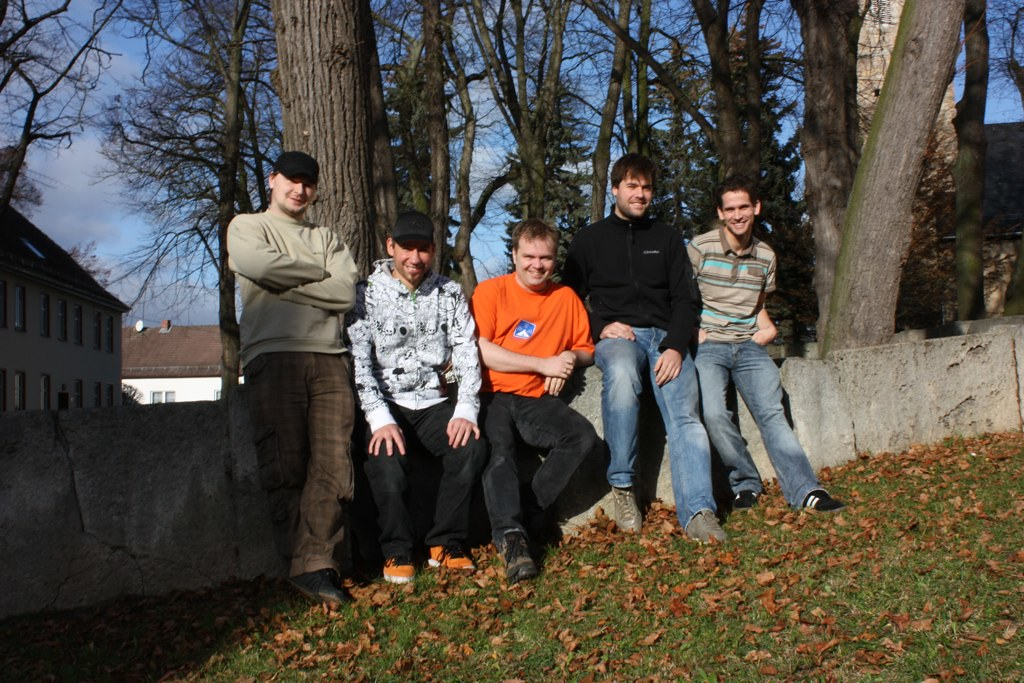
That makes 2026 an interesting anniversary. Grid Elements turns 15 this year, while the idea behind it is already 17 years old. What began with Backend Layouts at page level did not stop there. The same structural thinking continued into individual content elements and today forms the foundation for what Grid Elements makes possible.
Making structure visible
The idea began before the extension existed
In 2009, the TYPO3 User eXperience Week brought people together to rethink how working with TYPO3 could feel for editors. One of the teams focused on a deceptively simple problem.
The backend should make the actual structure of a page visible.
The resulting work included the Grid View, the Grid Wizard and what became Backend Layouts. Rows and columns could describe the structure of a page, while colPos connected that visible structure to the places where content belonged.
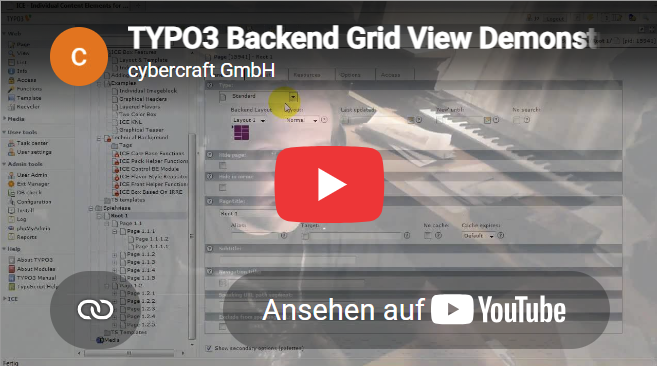
For editors, this created a much clearer relationship between what they saw in the backend and the page they were actually building. After that week, the idea was demonstrated in an early prototype called Modern BE. Parts of this work subsequently became part of TYPO3 4.5. Backend Layouts brought the page-level concept into the TYPO3 Core and established a structural language that TYPO3 editors still know today - yet pages were only part of the original idea.
Larger than pages
The same idea continues inside content
A page can have rows, columns and clearly defined areas for content. Once that model existed, the next step followed naturally. Structure also exists inside content.
The work that later led to Grid Elements continued the same line of thought from page level to content-element level. This continuity was conceptual as well as personal. The later development of Grid Elements was led by Jo Hasenau who had worked on the original Grid View concept and had brought it into TYPO3 Core.
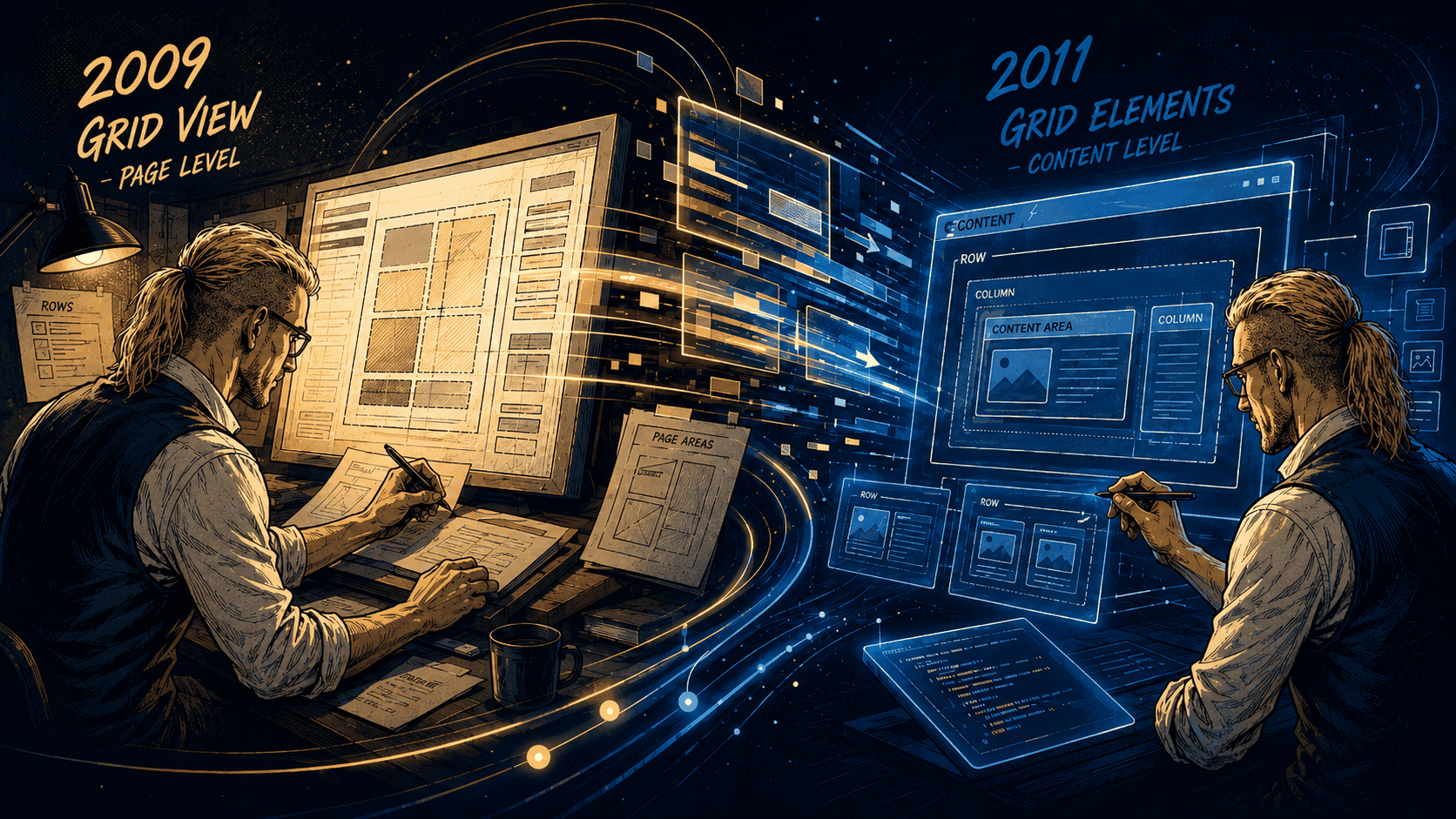
The underlying question therefore did not appear years later as a fresh interpretation of an existing feature. It came directly from the work that had started in 2009.
How could the same structural thinking continue inside the content itself?
In 2011, there was a very real opportunity to answer that question.
An idea meets editorial reality
Several hundred editors can teach you a lot about structure
At T-Systems, we were no longer dealing with a classic small website. WINS, the TYPO3-based knowledge and information system of Deutsche Telekom, was used by several hundred editors working with complex content and workflows, sometimes on the same pages at the same time. The structure had to remain clear and manageable even when many people were working with it.
At the same time, TemplaVoila was meant to be replaced because it was no longer the right fit for these requirements. Behind that decision was a very practical editorial question: How do you create a structure that editors can build and understand before they start filling it with content? It had to work for large teams and real production workflows. And the basic idea was already there.
That combination became Grid Elements.
The Semantic Web will bring structure to the meaningful content of Web pages.
The same structural language
moves into content
The same structural language that described pages could now describe structure inside content. A content element could define its own rows and columns. Those areas could contain child content.
Structures could be combined and nested where the editorial concept required it.
What had begun as a page-level model continued as a content-level authoring model.
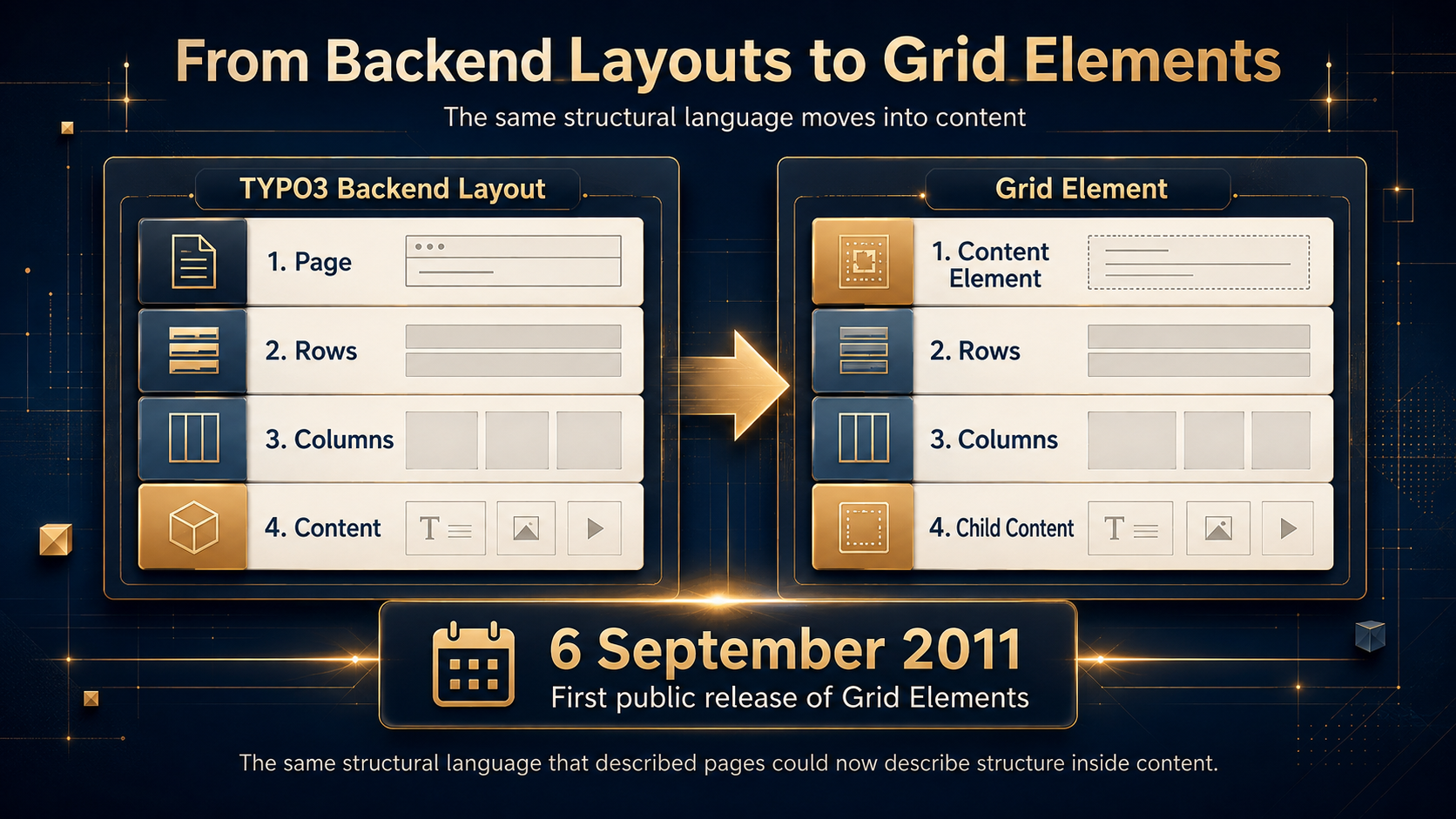
September 2011, Grid Elements was released in the TYPO3 Extension Repository for the first time. At that point, the important achievement was larger than adding another kind of content element. Grid Elements had taken a structural idea that started with TYPO3 itself and continued it across the boundary between pages and content.
Structure-first Authoring
Build the framework before writing the first line
Once structure becomes available inside content, editors can work in a different order. They can start by building the functional framework of a page. Areas for different kinds of content can already be visible. Containers can define meaningful sections.
More complex structures can be prepared before texts, images and other details are ready. Before writing the first headline, editors can build the full functional framework of the page.
That is what we mean by Structure-first Authoring.
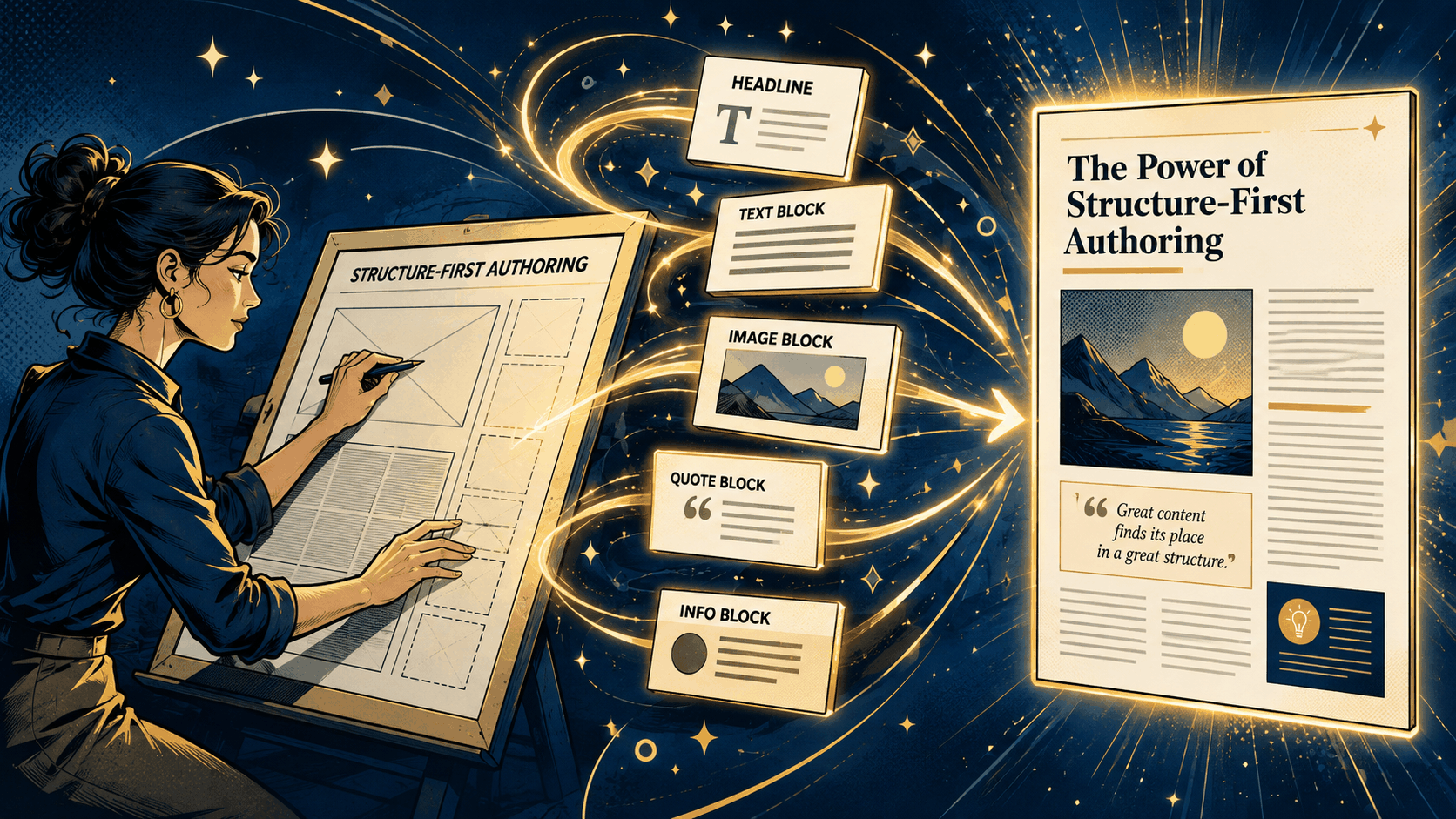
Structure-first Authoring means building the meaningful framework first, so the content that follows already has a place, a relationship and a context. Drag-and-drop certainly makes working with such structures convenient. The deeper value comes from the structure itself. It becomes part of the editorial model and can express relationships between pieces of content in a way that a visually flat sequence cannot.
So the actual killer feature is the Drag-In-Wizard, which lets power users create that structure in just a few seconds.
A grid can describe where things belong. A richer structural model can also help describe how things belong together. This distinction becomes increasingly valuable as websites grow beyond collections of pages designed for one visual output. Content moves between channels, components and contexts. Information needs to remain understandable even when its presentation changes. Structure can carry meaning of its own.
Built for humans
ready for machines
Seventeen years later the importance of explicit structure is growing. Backend Layouts did not disappear after TYPO3 4.5. The concept continued to evolve with TYPO3 and remains available in version 14 today.
Rows and columns are still there, colPos still connects page structure and content, Backend Layouts can still be configured and managed as part of a TYPO3 project, including file-based configuration that can live alongside the rest of a project's versioned setup. That continuity matters because the world around the concept has changed dramatically.

When the original work began in 2009, the immediate goal was to help editors understand and create page structure. Today, content travels further, appears in more contexts and increasingly needs to carry enough information for people and systems to understand what belongs together and why.
That is why the idea behind Grid Elements matters even more today. Modern content increasingly depends on explicit structure, context and meaning. Grid Elements can carry additional information about context and purpose alongside its structural model, capabilities we will explore throughout this series.
In 2009, we set out to make meaningful structure visible and usable for editors. In 2011, Grid Elements carried that idea from pages into content. Fifteen years later, clear structure, context and meaning have become more important than ever.
Their time has come.
Structure was only the beginning
The next questions followed naturally.
What happens when the same content needs to behave differently depending on where it appears?
Does every variation really need to become another Content-Type?
That question leads directly to the next part of our series and to another idea that has shaped Grid Elements from the beginning.
Grid Elements turns 15 on 6 September 2026, but the idea behind it is already 17 years old. It began at the TYPO3 User eXperience Week 2009 with the Grid View and Backend Layouts, making page structure visible and usable for editors. In 2011, Grid Elements carried that same structural language from pages into individual content elements. What emerged was more than a way to build grids or nest content. Grid Elements made structure part of the editorial model itself and laid the foundation for Structure-first Authoring, creating a meaningful framework before filling it with content. TYPO3 still uses the underlying Backend Layout concept today. At the same time, content increasingly moves between channels, components and contexts and needs to carry clear structure, context and meaning beyond any single presentation. That makes the original idea behind Grid Elements more relevant today than ever.


Testimonials
Coders.Care is the logical progression of the cooperation between providers of TYPO3 extensions and their users. Especially the point of communication during the preparation of a project will be optimized thereby. The developers can focus on their strenghts, while Coders.Care deals with questions, answers and management. In the consequence there will be clear statements about maintenance and further development of TYPO3 extensions, so the trust in TYPO3 and the projects implemented with it will be strengthened. As a TYPO3 agency we can only benefit of such a service.
© Copyright 2026 Cybercraft GmbH