Nothing has impact until it lands.

Information has always been a tool
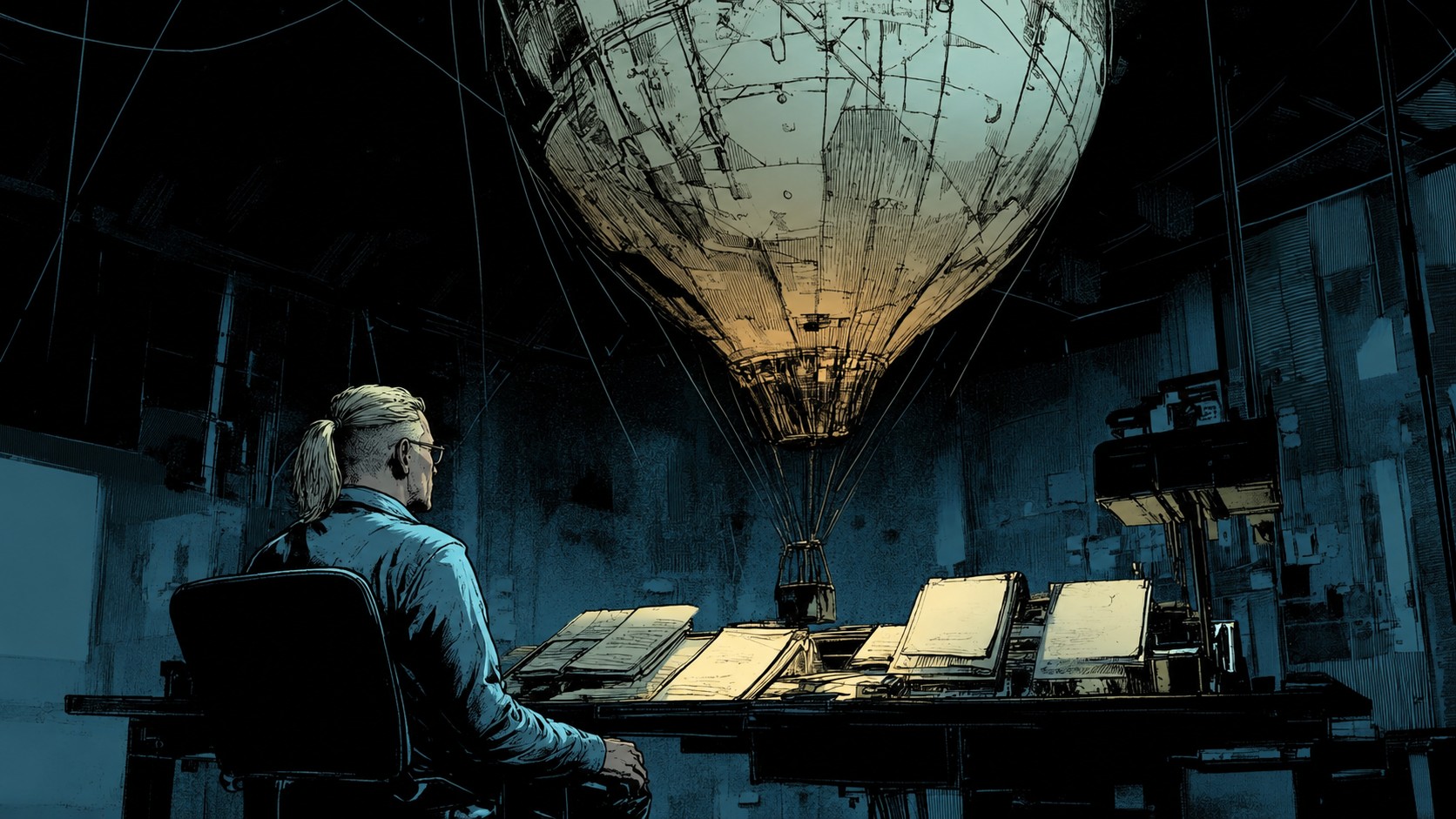
Leaflet balloons. They were real. Today, we would probably file them somewhere under “content delivery.” Back then, it was a little more hands-on: you attached paper to a balloon and hoped the wind, the timer, and the target area would cooperate.
Estimated reading time: 5 min
Information has weight
When distribution was still mechanical
At first, it sounds like something out of an old Cold War novel, but nobody made it up. Leaflets, newspapers, and other printed material really were carried across borders by balloon. You had to calculate the wind, secure the paper payload, and set up a simple mechanism that would release it after a certain amount of time. In the simplest version, it was almost absurdly basic: balloon, mechanism, kitchen timer, paper.
So you had to think about what information weighs. How long it stays in transit. Where it might land. And whether the right people would find it at all. That is a remarkably physical way of thinking about communication.
Today we talk about reach, distribution, targeting, and platform logic. Back then, the platform could be a piece of mechanics hanging under a hydrogen balloon.
This kind of information logistics has stayed with me for a long time because it makes something very obvious that tends to disappear in the digital world. Information needs a carrier. It needs a form, a route, a context. And it needs someone in whom it is meant to trigger something.
I first learned that in a very hands-on way. At the time, it even felt like a strange step backwards. I had already worked with computers. I knew screens, files, software, and digital tools. Then suddenly I was standing in a print shop, dealing with typesetting on daisy-wheel typewriters, printing film, manual assembly, plate exposure, and all the steps that turn a piece of text into a finished printed product.
For someone fascinated by computers, that felt like an odd direction at first. Less like a laboratory for the future and more like a workshop. There were materials, machines, and very tangible mistakes you could literally see in black and white afterwards.
Impact is not accidental
From printed sheets to outdoor advertising
Looking back, that was an important education. I learned that information only becomes real once it takes on a usable form. Text on a screen is a beginning. At some point it becomes film, then an exposed plate, later a printed sheet. And in the end, there is paper on a table that people can touch, take away, distribute, throw out, or read.
Later came a small advertising agency, and the perspective shifted. As an art director, it was no longer enough for something to be well typeset and cleanly produced. It had to have an effect. An ad had to survive in an environment where nobody had been waiting for it. A poster had to be understood faster than you might like. A campaign had to compress an idea enough to reach the right people without asking permission first.
Later still, at 3T, things became more physical again, only in a different way. Outdoor advertising and vehicle graphics put information onto surfaces that behave nothing like paper. A logo on a van is not the same thing as a logo in a file. It has to work on sheet metal, in traffic, in the rain, from a distance, and sometimes even when the customer would really prefer it bigger, brighter, and with the phone number added for good measure.
The material changes
The principle stays the same
Those may sound like very different stops along the way. To me, they are now connected by the same question: how does information have to be built so that it triggers something in people, organizations, or systems?
In print production, you learn that through processes and materials. In advertising, it is about attention and audiences. Politics, open source, and governance revolve around other forms of information, interpretation, trust, participation, and legitimate rules. Software adds another layer because information is not merely displayed there; it is structured, connected, and translated into processes.
Media production adds something many technical people underestimate. Information also works through voice, pace, rhythm, imagery, editing, music, atmosphere, and presence.
That is why what we do with Petra Likes Cooking – video, spoken text, music, and increasingly AI-assisted production – is not just a nice little hobby on the side to me. It is the same raw material in a different form. When Petra records a text, her voice changes its effect. Warmth, emphasis, pace, and small pauses all help determine whether something sounds warm, dry, ironic, approachable, or completely off.
More output is not the answer
When production suddenly becomes cheap
AI helps us in other places. With background music, for example, or production steps that used to require far more time or outside specialists. The effect comes from the interplay of people, tools, material, and decisions.
That is exactly why AI does not interest me as a magic machine for producing more output. More output is now the dullest promise in the entire show. Today, you can generate texts, images, music, drafts, and variations in a very short time that would have required half a production apparatus only a few years ago.
That shifts the real question. When production gets cheaper, control becomes more important. When variations are easier to create, selection becomes more important. When information moves through systems faster, responsibility becomes more important. The old balloon logic has not disappeared. It has simply found new carriers.
Who controls what we send out?
The balloon logic lives on
Back then, you had to think about when a balloon should launch, which way the wind was blowing, when the payload should be released, and where the paper might land. Today, we attach information to feeds, platforms, models, workflows, editorial systems, and decision-making processes. The terminology sounds more modern. The underlying question is remarkably similar: what are we sending out? Where is it going? Who receives it, who believes it, who acts on it, and who notices in time when the whole process starts going wrong?
That is where AI becomes interesting to me. It can write text, generate images, simulate voices, create music, and produce variations. Sometimes better, sometimes worse, often disturbingly polished, and occasionally with the confidence of a drunk management consultant. What makes it interesting is that it pushes the production, distribution, and adaptation of information into an entirely new scale.
The common thread
What the detours leave behind
If you see information only as content, you mostly see output. If you understand information as a material, you also see the questions behind it: what form does it take? Who trusts it? In which system does it operate? What feedback loop does it create, and who takes responsibility when it becomes more than just a harmless piece of text?
Maybe that explains why my path looks less chaotic to me now than it once did. First came the early work with computers. Then the print shop, followed by advertising and outdoor media. Later came software, community work, politics, and governance. Today, voice, video, music, and AI-assisted production have joined the mix.
It only looks random if you miss the common layer. Again and again, the work was about giving information a form in which it can make something happen.
It does not add up to a straight career path. It never did. But it does add up to a useful toolbox.
And that is something I can work with.
From leaflet balloons to print, advertising, software, and AI, I have kept coming back to the same question: how does information need to be transported, shaped, and controlled to actually have an effect? The cheaper and faster production becomes, the more important selection, context, feedback, and responsibility become. The carrier changes. The logic behind it changes surprisingly little.
© Copyright 2026 Cybercraft GmbH