Don’t click. Understand.

When mistakes end up stacked on pallets in a warehouse
Some mistakes live on a screen. Others eventually take up physical space in the room. In analogue production, that was not a metaphor.
Estimated reading time: 4 min
When mistakes gain weight
Approval suddenly gets very real
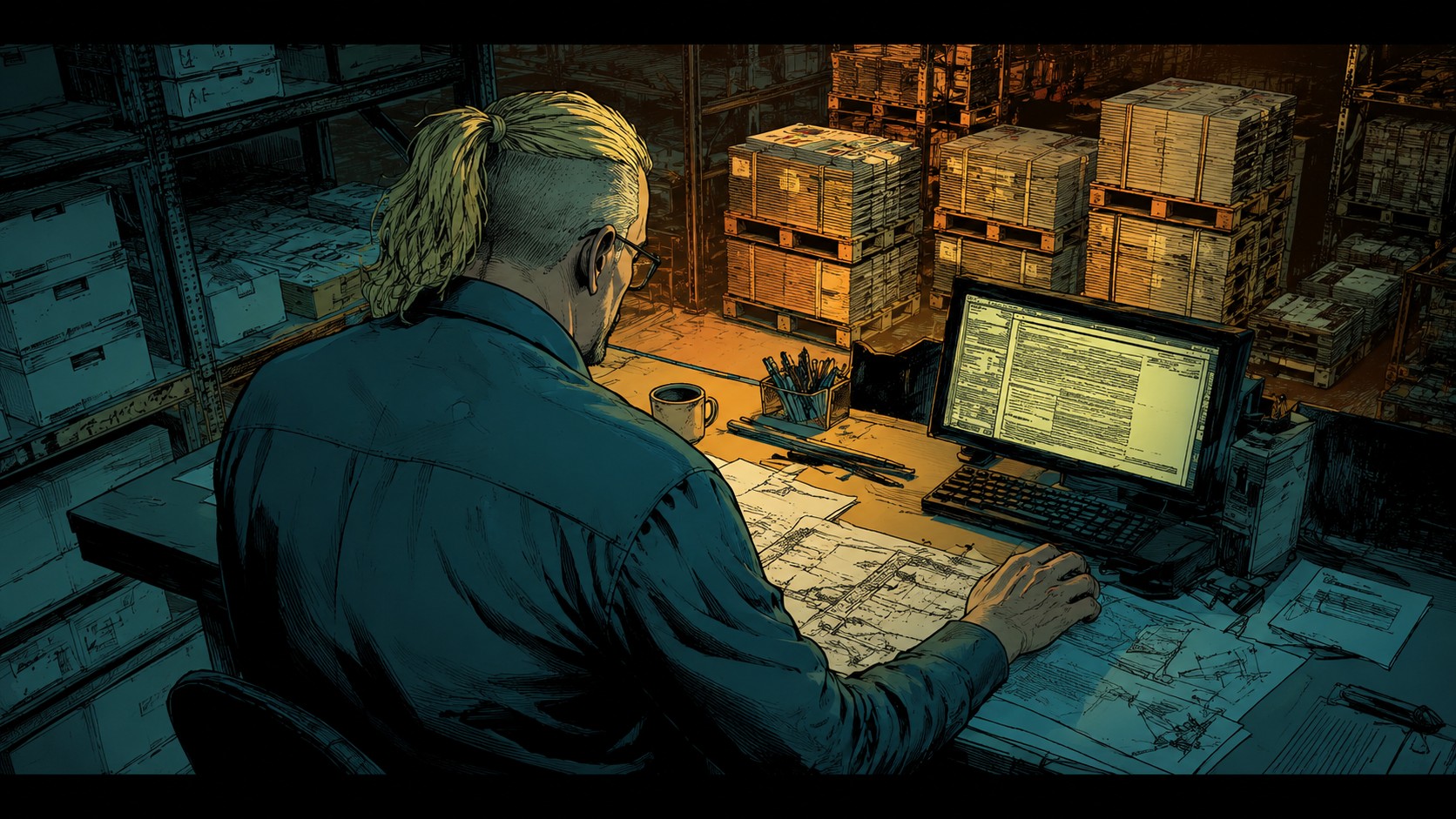
Once print data had been approved, films exposed, plates made, paper ordered, and the print run produced, a mistake eventually ended up in the warehouse. Stacked, paid for, heavy, and very real. If you have worked like that, you develop a different relationship with approvals. Quality control often sounds like process jargon today, a certificate and a folder nobody opens voluntarily. In production, it was the difference between “ships” and “burns money.”
I come from that world. Print, vinyl, outdoor advertising, vehicle graphics, production data, design, materials, and machines belonged together for me from early on. Information had to be given a form that could have an effect. If that form was wrong, the mistake became visible, expensive, and sometimes final.
Tools do not replace understanding
Knowing where to click is not understanding
So moving to the web was never some romantic departure. Even then, the internet was already full of people who thought Comic Sans was a worldview. But it changed how we dealt with mistakes. Content could be changed, a template adjusted, a link repaired, a bug fixed. Mistakes did not become harmless, but many of them became easier to correct.
For me, that transition also happened through training. When the media designer profession emerged, web and digital media had to be taught in practical terms. From 1998 onwards, we had apprentices, so we needed learning material, structure, and a useful answer to the question of what exactly we were supposed to teach.
Back then, I actually took the mice away from my apprentices. Literally. They were not supposed to click something together in Dreamweaver and then marvel that HTML somehow came out the other end. They were supposed to learn keyboard operation, write and understand HTML and JavaScript, and grasp CSS at least as far as CSS could reasonably be grasped at the time.
If you only operate the interface, you do not understand the system. Professionally clicked-together rubbish is still rubbish. It just comes with a nicer toolbar.
Technology meets responsibility
A CMS is a production environment
When TYPO3 entered the picture later on, a CMS was never just a website builder to me. A CMS is a production environment for information. The goal is to structure content so people can work with it every day without regularly causing small digital traffic accidents.
That brought the old questions back: who is allowed to publish? Who understands the structure? Who is responsible? Who can break something? Who can fix it? And who has to work every day with a system somebody else built?
At that point, software stops being just software. Content software is a socio-technical system. It only works when technical architecture, human workflows, organizational responsibility, and real-world use fit together. Otherwise, even a technically clean system fails in practice because of a logic that was only ever a good idea inside the developer's head.
That was the point where web development became more than technology to me. It became production again. The material was no longer paper sitting in a warehouse, but structure inside a system. Information does not simply appear. It is produced, shaped, checked, approved, and put into effect. The tools change, but responsibility does not disappear with them.
The result is not enough
How you got there matters
Today, AI and agents put us in a similar place again, only with a new degree of ephemerality. AI usually does not store things the way a CMS does. It is not a cleanly versioned editorial system, not an archive, and not a database with traceable states. A result often emerges from a prompt, context, model state, and successive refinements without that path being preserved automatically.
The result is there. The path that produced it often is not.
With AI, traceability has to be created deliberately. Otherwise you are left with a result that sounds convincing, may even work, but whose origin is difficult to reconstruct. And as we know, when something sounds convincing, that is often where the dangerous part begins.
Agents need control
Automation makes mistakes faster
Agents make this problem more acute. In a way, they are the Dreamweaver of the automated generation. Back then, the temptation was to click websites together without understanding them. Today, it is to let processes execute without enough understanding. The tool produces something that looks usable. That is exactly why it becomes risky when nobody can judge the assumptions and possible failure modes hidden inside it.
I would not take AI away from anyone today - that would be silly and probably bad for morale - but the old mouse episode still reminds me that the real issue is our relationship with the tool. Am I using it because it takes work off my hands, or am I letting it take understanding away from me?
From the printed sheet to AI
Responsibility remains
That is why AI does not interest me as hype, a text machine, or glowing decoration for the future. I care about how to make such systems controllable, how to keep their paths traceable, and how to enable people to use tools sensibly without being hypnotized by their interfaces.
Maybe that is the thread running from the printed sheet through TYPO3 to AI: information is never just content. It is produced. And once it has an effect, you had better still know how it came to be.
From print production through TYPO3 to AI, I have kept coming back to the same question: who still understands what a tool is actually doing before its output starts having an effect? The easier production and automation become, the more important traceability, control, and responsibility become. Good tools take work off our hands. They should not take understanding away from us.
© Copyright 2026 Cybercraft GmbH